
Portuguese navigators helped reshape the map of the world during the 15th and 16th centuries. Their voyages connected Atlantic islands, the west coast of Africa, the Indian Ocean, Brazil, Southeast Asia and China with European maritime networks on an unprecedented scale.
But the familiar phrase Age of Discovery needs context. The lands and sea routes reached by Portuguese expeditions were already inhabited, traded across and known to the peoples who lived there. What changed was Portugal’s ability to connect these regions by long-distance ocean voyages and then turn maritime knowledge into trade, military power, settlement and empire.
The figures below did not all play the same role. Some were navigators, some royal patrons, some military commanders, and one led a Spanish expedition despite being Portuguese by birth. Together, however, their careers show how quickly Portugal moved from Atlantic exploration to a global maritime presence.
1. Prince Henry the Navigator: Patron of Expansion
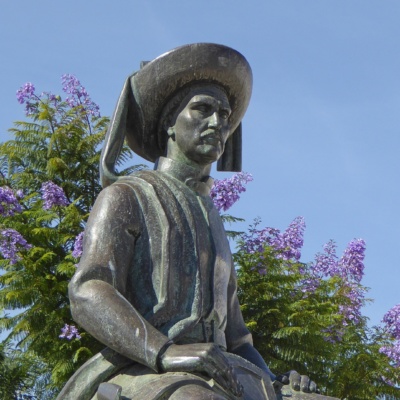
Infante Dom Henrique, commonly known in English as Prince Henry the Navigator.
Infante Dom Henrique, born in Porto in 1394, is better known in English as Prince Henry the Navigator. The nickname is misleading if it suggests that Henry personally led the famous voyages associated with him. His importance came primarily from political influence, patronage and the organization of maritime ventures.
Henry took part in Portugal’s conquest of Ceuta in 1415, an event commonly treated as the beginning of Portuguese overseas expansion. He later became governor of the Order of Christ and developed extensive political and economic interests connected to Atlantic islands, North Africa and the west coast of Africa.
Under Henry’s patronage, Portuguese voyages moved progressively farther down the African coast. He also became involved in the settlement and economic development of Madeira and the Azores. Madeira’s sugar economy and the Atlantic settlement system would become important precedents for later Portuguese expansion.
Henry’s legacy also includes darker aspects of early Atlantic expansion. Raiding and the capture and sale of enslaved Africans became part of the commercial system developing under Portuguese maritime activity during his lifetime. The beginnings of Portugal’s global expansion cannot be separated from the beginnings of its participation in the Atlantic slave trade.
2. Gil Eanes: Beyond Cape Bojador
Gil Eanes is less famous than Vasco da Gama or Ferdinand Magellan, but his 1434 voyage became one of the symbolic turning points of early Portuguese exploration.
Cape Bojador, on the coast of what is now Western Sahara, had acquired an intimidating reputation among European sailors. Dangerous currents, reefs and limited geographical knowledge made it seem like a practical barrier to further exploration.
In 1434, Eanes successfully sailed beyond the cape and returned to Portugal. The achievement did not suddenly reveal an unknown world, but it demonstrated to Portuguese crews that regular voyages farther down the African coast were possible.
Once Bojador ceased to be treated as a boundary, Portuguese expeditions moved steadily south. Within a few decades, sailors and merchants were reaching the Senegal and Gambia regions, the Gulf of Guinea and eventually the southern Atlantic coast of Africa.
3. Bartolomeu Dias: Rounding Southern Africa
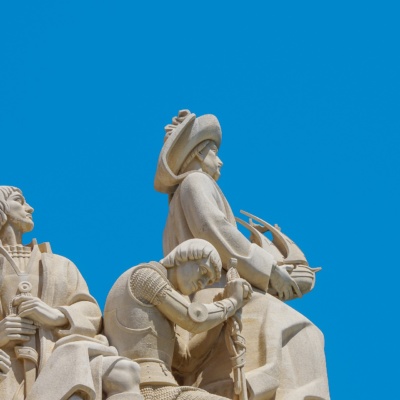
Portugal’s Monument to the Discoveries in Belém, Lisbon.
Bartolomeu Dias achieved one of the most important navigational breakthroughs in European maritime history. Sailing for King João II, he departed Portugal in 1487 with the goal of pushing farther around Africa and determining whether the continent could be rounded by sea.
In early 1488, Dias’s ships were driven far from the coast and eventually reached waters east of Africa’s southern cape. By tracing the coastline after turning back toward land, the expedition realized that it had successfully rounded the southern tip of the continent.
Dias therefore became the first European navigator known from surviving records to round southern Africa and enter the Indian Ocean from the Atlantic. His voyage demonstrated that a maritime route from Portugal toward the Indian Ocean was possible.
The cape became known as the Cape of Good Hope, a name that captured exactly what the voyage meant to Portugal: the possibility of reaching the rich trading networks of the Indian Ocean by sea.
Dias himself never led the breakthrough voyage to India. He later participated in Pedro Álvares Cabral’s fleet in 1500 and died when his ship was lost in a storm near the same southern African waters he had helped make famous.
4. Vasco da Gama: Portugal Reaches India by Sea
Vasco da Gama built directly on the maritime knowledge developed by Dias and generations of Portuguese pilots. He left Lisbon in July 1497 with four vessels and sailed down the Atlantic, around southern Africa and into the Indian Ocean.
On May 20, 1498, da Gama reached Calicut, today’s Kozhikode, on India’s Malabar Coast.
It is inaccurate to say that Vasco da Gama “discovered India.” India had ancient cities, states and extensive commercial links with Arabia, East Africa and Asia long before Portuguese ships arrived. What da Gama accomplished was the establishment of a direct European maritime route from Portugal around Africa to India.
That distinction matters. The Indian Ocean was already one of the world’s great trading systems. Portuguese ships entered that existing network and then attempted to redirect parts of it through armed maritime power, fortifications and control of strategic routes.
Da Gama returned to Portugal in 1499. His voyage transformed Portuguese ambitions. A route that had been theoretical after Dias’s voyage could now be sailed from Lisbon to India, giving the crown direct access to the spice trade and encouraging increasingly aggressive Portuguese involvement in the Indian Ocean.
His voyage also became central to Portuguese national memory. Luís de Camões later used da Gama’s journey as the narrative framework for Os Lusíadas (The Lusiads), the great 16th-century Portuguese epic.
5. Pedro Álvares Cabral: Brazil and the Route to India
Pedro Álvares Cabral left Lisbon in March 1500 at the head of a large fleet bound for India. His mission followed the route opened by da Gama but on a much larger commercial and diplomatic scale.
The fleet sailed far into the western Atlantic before reaching the coast of present-day Brazil on April 22, 1500. Cabral claimed the land for the Portuguese crown and sent news of the encounter back to King Manuel I.
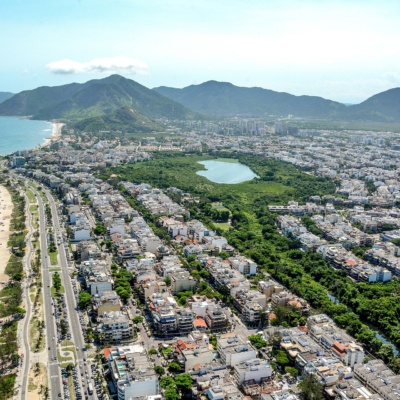
Cabral’s fleet reached the coast of present-day Brazil in April 1500.
Again, “discovery” must be used carefully. Brazil was already home to large and diverse Indigenous populations, and historians continue to debate what Portuguese navigators may have known about the western South Atlantic before Cabral’s voyage. What is certain is that Cabral’s expedition established Portugal’s formal claim to the territory that would become Brazil.
Cabral then continued toward India. The voyage suffered severe losses while crossing the South Atlantic and rounding the Cape of Good Hope, including the death of Bartolomeu Dias. The surviving ships reached India, where Portuguese commercial ambitions quickly became entangled with diplomacy and violence.
Cabral’s voyage connected two regions that would become crucial to Portugal’s empire: Brazil in the Atlantic and India in the Indian Ocean.
6. Afonso de Albuquerque: Turning Voyages Into an Empire
Afonso de Albuquerque was not primarily an explorer in the same sense as Dias or da Gama. He was a naval commander, strategist and governor whose career shows the next phase of Portuguese expansion: turning maritime routes into fortified political power.
Albuquerque became governor of the Portuguese Estado da Índia and pursued a strategy of controlling strategically important ports and maritime chokepoints.
In 1510, Portuguese forces under his command captured Goa, which became the principal administrative center of Portuguese power in Asia. In 1511, he captured Malacca, one of Southeast Asia’s most important commercial ports and a key link between the Indian Ocean and the South China Sea.
These conquests reveal how quickly Portuguese expansion changed character. Early voyages had focused on finding routes and gathering geographical knowledge. By Albuquerque’s era, Portugal was using heavily armed fleets and fortified bases to influence international commerce.
His career belongs in the story of Portuguese exploration precisely because it demonstrates that exploration, commerce and empire soon became inseparable.
7. Jorge Álvares: Portuguese Contact With China
Jorge Álvares is a lesser-known figure but an important one in the eastern reach of Portuguese expansion. In 1513, sailing from Portuguese-controlled Malacca, he reached the coast of southern China in the Pearl River Delta.
He is generally credited as the first Portuguese — and the first European in the Age of Exploration known from the maritime record — to reach China directly by sea.
Álvares did not establish Macau, but voyages like his opened a period of complicated Portuguese commercial and diplomatic contact with China. Portuguese merchants eventually gained a permanent base at Macau in the 16th century. Macau remained under Portuguese administration until its transfer to China in 1999.
8. Ferdinand Magellan: Portuguese Navigator, Spanish Expedition
Fernão de Magalhães, known in English as Ferdinand Magellan, presents one of the most interesting cases in Portuguese maritime history.
Magellan was Portuguese and had already served in Portuguese expeditions in Asia. He later proposed reaching the Moluccas — the Spice Islands — by sailing westward around the Americas. After failing to secure support from King Manuel I of Portugal, he took the plan to Spain.
King Charles I approved the project, making the famous expedition of 1519–1522 a Spanish expedition led initially by a Portuguese navigator.
Magellan’s fleet found and crossed the strait at the southern end of South America that now bears his name. The expedition then made the first recorded European crossing of the Pacific Ocean.
Magellan, however, did not complete the first circumnavigation of the world. He was killed on April 27, 1521, during fighting on the Philippine island of Mactan.
After his death, command changed several times. Juan Sebastián Elcano eventually led the ship Victoria across the Indian Ocean and around the Cape of Good Hope. The vessel returned to Spain in September 1522, completing the first historically documented circumnavigation of the globe.
Magellan remains essential to that achievement because he planned and led the expedition through its Atlantic, South American and Pacific stages. But credit for completing the voyage belongs to Elcano and the surviving crew of the Victoria.
What Made Portuguese Navigation Possible?
Portugal’s maritime expansion was not the work of a handful of heroic individuals acting alone. Every famous captain depended on pilots, sailors, shipwrights, cartographers, interpreters, merchants and knowledge acquired from people encountered along the route.
Several practical developments helped Portuguese ocean navigation advance:
- Atlantic sailing experience: generations of Portuguese fishermen and merchants already operated in difficult Atlantic conditions.
- Improved use of winds and currents: sailors learned to use broad ocean routes rather than simply following coastlines.
- Ship design: caravels and larger ocean-going vessels were adapted for different types of exploration and trade.
- Astronomical navigation: mariners used instruments and observations of the sun and stars to estimate latitude.
- Cartography and accumulated knowledge: each successful voyage added information that could be used by later expeditions.
- Cross-cultural knowledge: Portuguese expeditions relied repeatedly on local pilots, interpreters and existing trade networks in Africa and Asia.
This last point is especially important. European maritime expansion did not happen in an empty world. Portuguese navigators entered regions where African, Arab, Persian, Indian, Malay and Chinese sailors already possessed sophisticated geographical and commercial knowledge.
Exploration, Trade, Conquest and Slavery
Portuguese maritime history is often celebrated for navigation, shipbuilding and geographical knowledge. Those accomplishments were real, but they were connected to consequences that also need to be part of the story.
Portuguese expansion brought new long-distance connections between continents, but it also produced military conquest, forced conversion, colonial rule and an enormous expansion of slavery. Portuguese merchants became major participants in the Atlantic slave trade, while fortified positions in Africa and Asia were often maintained through armed force.
That fuller history is explored in Part 1: The Portuguese Empire.
Where to See Portugal’s Maritime History
Travelers can still see this era reflected throughout Portugal. In Belém, Lisbon, the Jerónimos Monastery, Belém Tower and Monument to the Discoveries are closely associated with the country’s maritime history. The Museu de Marinha adds ships, maps, navigational instruments and historical context.
In the Algarve, Lagos and Sagres are strongly associated with Prince Henry and early Atlantic expansion, although some later legends about a formal “School of Sagres” should not be confused with documented history.
Tomar also matters because the Convent of Christ preserves the history of the Order of Christ, the religious-military order whose wealth and institutional role became connected to Portuguese expansion.
Start with our Lisbon travel guide and the broader History of Portugal section.
Portuguese Explorers: Key Dates
- 1415: Portugal captures Ceuta; Prince Henry participates.
- 1434: Gil Eanes sails beyond Cape Bojador.
- 1488: Bartolomeu Dias rounds southern Africa.
- 1498: Vasco da Gama reaches India by sea from Portugal.
- 1500: Pedro Álvares Cabral’s fleet reaches Brazil.
- 1510: Afonso de Albuquerque captures Goa.
- 1511: Albuquerque captures Malacca.
- 1513: Jorge Álvares reaches southern China by sea.
- 1519: Magellan’s Spanish-sponsored expedition begins.
- 1521: Magellan dies at Mactan in the Philippines.
- 1522: Elcano and the Victoria complete the first documented circumnavigation.
Frequently Asked Questions
Who was the most famous Portuguese explorer?
Vasco da Gama is probably the most internationally recognized Portuguese navigator because his 1497–1499 voyage established a direct sea route from Portugal to India around Africa. Prince Henry the Navigator and Ferdinand Magellan are also among the best-known Portuguese figures associated with maritime exploration.
Did Vasco da Gama discover India?
No. India was home to ancient civilizations and well-established regional and international trade networks. Da Gama’s achievement was establishing a direct European maritime route from Portugal to India around Africa in 1498.
Did Pedro Álvares Cabral discover Brazil?
Cabral’s fleet reached the Brazilian coast in 1500 and formally claimed the territory for Portugal. Brazil was already inhabited by Indigenous peoples, so modern historical writing generally distinguishes the Portuguese arrival and claim from the idea that the land itself was “discovered.”
Was Ferdinand Magellan Portuguese?
Yes. Fernão de Magalhães was born in Portugal and previously served Portuguese interests in Asia. His famous 1519 expedition, however, was sponsored by Spain.
Was Magellan the first person to sail around the world?
No. Magellan died in the Philippines in 1521. The expedition continued, and Juan Sebastián Elcano commanded the Victoria on the final voyage back to Spain in 1522, completing the first historically documented circumnavigation.
Why did Portugal become such an important maritime power?
Portugal combined Atlantic sailing experience, royal investment, accumulated navigational knowledge, suitable ships and a strategic interest in overseas commerce. Its location on Europe’s Atlantic coast also encouraged sustained maritime activity.
Sources and Further Reading
- Encyclopaedia of Portuguese Expansion — Prince Dom Henrique
- South African History Online — Bartolomeu Dias
- Oxford University Press — Vasco da Gama Reaches Calicut
- Brazilian National Library — Cabral’s Fleet Reaches Brazil
- Encyclopaedia of Portuguese Expansion — Fernão de Magalhães
- National Historical Commission of the Philippines — Magellan’s Death and the First Circumnavigation