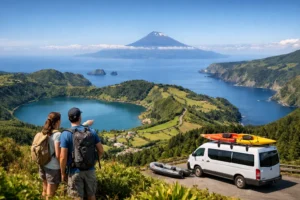

Pico rises from the Atlantic like a dark green pyramid, its 7,713-foot summit often wearing a collar of cloud. This Pico Island guide is for travelers who want more than a quick look at Portugal’s highest mountain. Pico rewards a slower stay: a morning among black-stone vineyards, an afternoon on the water watching for whales, and a relaxed dinner with local wine while neighboring Faial glows across the channel.
For many travelers, Pico is the Azores at its most elemental. It is less built-up than São Miguel, wonderfully scenic, and especially satisfying for couples, families, and repeat visitors who prefer authentic island time over a tightly packed sightseeing schedule. Pico can be visited independently or incorporated into one of Portugal Online’s Azores vacation packages, which combine the island with Faial, São Miguel, Terceira and other parts of the archipelago.
The trade-off is that Pico’s attractions and services are spread across the island and public transportation is limited. A well-planned rental car, the right hotel location, and a realistic itinerary make a noticeable difference. Travelers who prefer to explore independently can also compare Portugal Online’s Azores self-drive vacations, with accommodations, transportation and island connections arranged in advance.
Why Pico Deserves a Place in Your Azores Trip
Pico belongs to the central group of the Azores, alongside Faial and São Jorge. Its identity is shaped by volcanic land, seafaring traditions, wine production and the unmistakable presence of Mount Pico. The island is roughly 29 miles long, so driving distances are manageable, but roads wind through coastal communities and the best sights are scattered rather than concentrated in one town.
The mountain is the visual anchor, but Pico is not only for hikers. The island’s UNESCO-listed vineyard landscape near Madalena is reason enough to visit. Here, thousands of small vineyard plots are enclosed by low walls of dark basalt, built to shelter vines from Atlantic wind and salt spray. The result is both practical and extraordinarily beautiful: a geometric patchwork of black stone and green vines extending toward the sea.
Pico also has one of the Azores’ strongest connections to whale watching. Whaling was once central to island life; today, wildlife excursions offer a very different reason to head offshore. Sperm whales can be encountered in Azorean waters throughout the year, while the presence of other whale and dolphin species changes with the seasons. Sightings can never be guaranteed, but Pico remains one of the archipelago’s important bases for marine excursions.
If whale watching, island sightseeing or other local experiences are a priority, browse the current selection of Azores day tours and activities before traveling. Advance reservations are particularly useful during the busier summer months.
Pico Island Guide: Where to Stay and How to Get Around
Madalena, on the west coast, is the most convenient base for many first-time visitors. It has the island’s principal ferry terminal, restaurants and useful services, as well as clear views across the channel toward Faial. Staying here also makes it easy to combine Pico with Horta, either as a day trip or as part of a longer central-islands itinerary.
For a quieter setting, consider the south coast around Lajes do Pico or one of the smaller coastal communities. Lajes has deep whaling history, an attractive harbor and a more traditional feel. The north coast is often greener and more remote, with natural swimming areas and fewer visitors. It can be an excellent choice for travelers who value peace and scenery, although driving times to Madalena and the main vineyard area will be longer.
Renting a car is generally the most practical way to explore Pico independently. Roads are usually manageable, although some village streets are narrow and steep. Reserve early for summer travel, particularly if you require an automatic-transmission vehicle. Driving slowly is part of the experience: viewpoints, small harbors, vineyards and swimming areas often provide the best reasons to stop.
Taxis and organized excursions can work well for shorter stays or for travelers who would rather not drive, but advance coordination is important. For an itinerary that combines vineyards, natural pools, trailheads and several parts of the island, having transportation planned in advance provides much more flexibility.
If you enjoy independent travel but would rather not assemble hotels, rental cars, ferry tickets and inter-island transportation separately, the 7-day Faial, Pico and São Miguel self-drive vacation is one way to incorporate Pico into a prearranged Azores itinerary.
The Experiences That Make Pico Special
Climb Mount Pico, or Enjoy It From Below
An ascent of Mount Pico is a memorable challenge, not a casual walk. The route is steep, rocky and exposed to rapidly changing weather, and the full outing can take much of the day. Hikers should have appropriate fitness, sturdy footwear, water, food and layers for changing conditions. Access and registration requirements should always be checked before the climb.
Hiring an experienced local guide is worth considering, particularly for first-time visitors unfamiliar with volcanic terrain or Azorean weather. Guided hiking experiences may also be available through Portugal Online’s Azores tours and activities section.
If the summit is not for you, Pico still delivers magnificent mountain scenery in gentler ways. Drive through the highlands, visit Lagoa do Capitão for one of the classic mountain views on a clear day, or choose a lower-elevation walk through vineyards and coastal communities. Some of the best views of Pico happen early in the morning, before clouds gather around the summit.
Walk the Vineyard Culture Landscape
The vineyard area between Madalena and the northwest coast is best explored without rushing. Around Criação Velha and the surrounding wine-growing areas, walking paths reveal the extraordinary scale of the traditional stone-wall system. Black basalt walls divide the landscape into thousands of small plots, while the Atlantic and Mount Pico form a dramatic backdrop.
Leave time for a wine tasting or a visit connected with Pico’s winemaking history. The island’s wines are shaped by volcanic terrain, Atlantic weather and generations of working vines in an unusually challenging environment. Tastings provide useful context for the landscape, but they are also an enjoyable way to slow the pace of a sightseeing day.
Smaller producers may have limited or seasonal visiting hours, so confirm arrangements in advance rather than assuming every winery accepts walk-in visitors.
Go Whale and Dolphin Watching Responsibly
From Madalena or Lajes do Pico, whale- and dolphin-watching excursions head into deep Atlantic waters where marine life can sometimes be encountered surprisingly close to the islands. Choose an operator that follows responsible wildlife-viewing practices, provides proper safety instructions and adjusts departures according to sea conditions.
Morning departures can sometimes mean calmer conditions, although Atlantic weather is never entirely predictable. Travelers prone to motion sickness should prepare before boarding and avoid scheduling an important flight, long ferry connection or demanding mountain hike immediately afterward.
If marine wildlife is one of the main reasons for your trip, compare available whale watching and Azores experiences before finalizing the rest of your itinerary.
Swim in Natural Pools and Follow the Coast
Pico’s lava-formed natural swimming areas are one of the pleasures of a summer visit. Facilities and access vary, and sea conditions should always take priority over plans. On calm days, these pools offer a distinctly Azorean swim: clear Atlantic water surrounded by volcanic rock and wide-open ocean views.
The coastal drive is also part of the experience. Stop in São Roque do Pico to explore the island’s maritime heritage, continue through quieter northern villages, and leave time for viewpoints rather than treating the road simply as a route between attractions. On the south coast, Lajes do Pico and its harbor make an excellent place for a slow afternoon.
Pairing Pico With Faial or São Jorge
Pico works particularly well as part of an Azores multi-island vacation. Its closest and easiest partner is Faial, connected across the channel between Madalena and Horta. Faial’s marina, Caldeira and Capelinhos volcanic landscape provide a striking contrast to Pico’s vineyards, villages and towering mountain.
Portugal Online’s 7-day Faial, Pico and São Miguel tour is designed around this natural pairing. Travelers stay on Faial, cross to Pico for a full-day island excursion, and then continue to São Miguel, allowing three distinctly different Azorean islands to fit into a one-week itinerary without excessive hotel changes.
Travelers with more time can expand the journey. A 10-day four-island Azores itinerary adds Terceira to Faial, Pico and São Miguel, creating a broader mix of volcanic scenery, historic towns, vineyards, maritime traditions and geothermal landscapes.
São Jorge is another appealing addition for travelers interested in dramatic cliffs, fajãs, walking and local food traditions. Ferry schedules can be seasonal and weather-dependent, so Azores island hopping should always be planned with enough flexibility for transportation changes.
If you have only three or four nights in the central Azores, concentrating on Pico and Faial may be more rewarding than trying to collect islands. With a week or longer, adding São Miguel or Terceira becomes much easier.
Flights are another consideration. Air connections within the Azores can make an open-jaw itinerary practical, allowing travelers to arrive on one island and depart from another rather than continually backtracking. This becomes particularly useful on multi-island trips where ferries and flights must work together.
When to Visit Pico Island
Late spring through early fall is the most popular period for visiting Pico, with warmer temperatures, longer days and the broadest selection of sightseeing and outdoor activities. July and August usually bring the strongest demand for hotels, cars and tours, so advance reservations are particularly important.
June and September can be excellent alternatives, combining green landscapes and comfortable conditions with a somewhat quieter atmosphere. Spring and fall can also be rewarding for travelers who value scenery and fewer visitors more than swimming weather.
Weather in the Azores can change several times in a single day in any season. Pack a waterproof layer, comfortable walking shoes, sun protection and clothing that can be layered. A cloudy mountain does not necessarily mean a lost sightseeing day: one part of Pico can be covered in mist while another coast is bright and calm.
Planning a Pico and Azores Vacation
Pico is not an island to rush through or over-schedule. Give yourself enough time for changing weather, an unexpected coastal stop, a lingering vineyard lunch and the possibility that Mount Pico will suddenly emerge from the clouds just when you have stopped looking for it.
Travelers who want the logistics organized in advance can start by comparing Portugal Online’s Azores vacation packages. Current itineraries include combinations of Pico, Faial, São Miguel, Terceira and Flores, with different options for travelers who prefer guided touring or independent exploration.
If you would rather drive and explore at your own pace, see the Azores self-drive vacation collection. If your hotels and transportation are already arranged and you simply want to add local experiences, browse Azores tours and activities for sightseeing, whale watching, hiking and other experiences.
For a trip that does not fit an existing package, use the Portugal Vacation Planner to tell our travel specialists your dates, preferred islands, travel style, hotel preferences and interests. Portugal Online can then help coordinate the accommodations, transportation, island connections and selected experiences into a Pico and Azores vacation built around the way you want to travel.