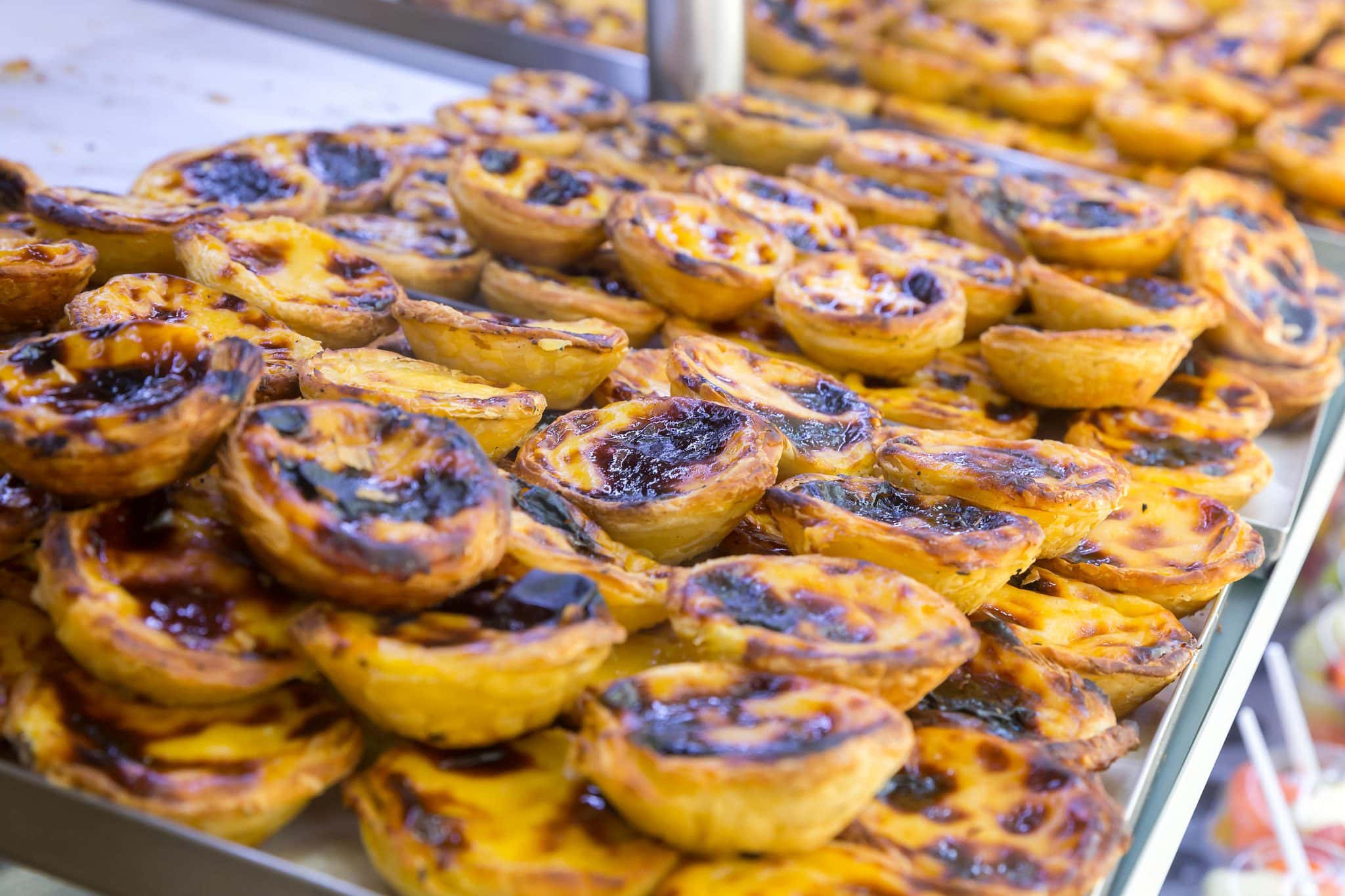
Few foods are as instantly associated with Portugal as the pastel de nata: a small puff-pastry tart filled with egg custard and baked until the top develops dark caramelized spots. Served warm with cinnamon — and often powdered sugar — it is one of the simplest and most recognizable pleasures of Portuguese café culture.
But there is an important distinction that often gets lost outside Portugal: a pastel de nata and a Pastel de Belém® are related, but they are not interchangeable names. Pastéis de Belém are the specific pastries made at the historic bakery in Lisbon’s Belém district using its closely guarded recipe. Pastéis de nata are the broader Portuguese custard-tart tradition found in pastry shops across the country.
This guide explains the history, the difference between the two names, how to eat them in Portugal, and how to make a very good home-style pastel de nata. It does not claim to reproduce the secret Pastéis de Belém recipe.

Portuguese custard tarts: crisp pastry, soft custard and a caramelized top.
The Story of Pastéis de Belém
The documented history is slightly different from the popular story often repeated online.
According to the official history of Pastéis de Belém, a sugar-cane refinery and small general store operated beside the Jerónimos Monastery in Belém in the early 19th century. After Portugal’s Liberal Revolution, religious houses were closed in 1834 and clergy and workers were expelled from convents and monasteries.
In an effort to survive, someone connected with the monastery began selling sweet pastries in the nearby shop. They became known as Pastéis de Belém. In 1837, production began in buildings attached to the refinery using what the bakery describes as an old monastery recipe. That recipe is still kept secret and known only to the master confectioners who prepare the pastries in the bakery’s Oficina do Segredo, or “Secret Workshop.”
The often-repeated explanation that monasteries used huge quantities of egg whites to starch clothing and therefore had leftover yolks is part of broader Portuguese conventual-sweets lore, but it is not the core origin story given by the Pastéis de Belém bakery itself. The better-supported story is the post-1834 closure of the monastery and the sale of pastries as a means of survival.
Belém was then outside the center of Lisbon and commonly reached by steamboat. The Jerónimos Monastery and nearby Belém Tower already attracted visitors, and the pastries quickly became part of the experience of visiting the district.
Pastel de Nata vs. Pastel de Belém: What Is the Difference?
Pastel de Nata
The generic Portuguese custard tart: laminated pastry filled with an egg-rich custard and baked at very high heat until blistered and caramelized. You can find versions throughout Portugal.
Pastel de Belém®
The specific pastry made by the historic Pastéis de Belém bakery in Lisbon. Its recipe is secret, and the bakery identifies its product by the protected Pastéis de Belém name.
The plural is also useful to know:
- one: pastel de nata
- more than one: pastéis de nata
- the Belém bakery product: Pastel de Belém / Pastéis de Belém
In everyday conversation, Portuguese people may simply ask for a nata, especially in a café or pastry shop where the meaning is obvious.
What Makes a Great Pastel de Nata?
The contrast is the key. The pastry should be crisp, flaky and layered rather than soft like ordinary pie crust. The filling should remain creamy and tender, but the surface should develop characteristic dark brown — sometimes nearly black — caramelized patches.
The blistered top is not a mistake. Pastéis de nata are baked at a much higher temperature than most custard desserts. Commercial ovens used by specialist bakeries can reach temperatures well above those of a typical home oven. At home, the goal is therefore to use the highest safe temperature your oven can maintain and bake the tarts quickly.
Cinnamon is traditional. Powdered sugar is also common. The pastry is especially good while still slightly warm, often alongside a bica, the Lisbon term commonly used for a short espresso.
Home-Style Pastel de Nata Recipe
Ingredients
For the pastry
- 1 sheet or block all-butter puff pastry, about 14 oz / 400 g, thawed but still cold
- Butter for greasing the muffin tin, if needed
For the custard
- 1 cup / 240 ml whole milk
- 2 tablespoons / about 18 g all-purpose flour
- 2/3 cup / about 135 g granulated sugar
- 1/3 cup / 80 ml water
- 1 cinnamon stick
- 2 strips lemon peel, with as little white pith as possible
- 6 large egg yolks
- Pinch of salt
For serving
- Ground cinnamon
- Powdered sugar, optional
Instructions
- Heat the oven. Place a rack in the upper third of the oven and preheat to 500°F / 260°C, or to the highest safe temperature your oven allows. Give the oven plenty of time to become fully hot.
- Prepare the pastry spiral. Roll the puff pastry into a tight log from the short side. Chill for about 15 minutes so it is firm enough to slice neatly.
- Portion the pastry. Cut the log into 12 equal rounds. Place one round cut-side down into each cup of a standard muffin tin. With damp thumbs, press the pastry outward and upward, making the bottom thinner than the sides. Chill while preparing the filling.
- Make the milk mixture. Whisk the flour with about 1/4 cup of the milk until completely smooth. Bring the remaining milk just to a simmer, then gradually whisk it into the flour mixture. Return it to low heat for a minute or two, whisking, just until slightly thickened. Do not make a heavy pudding.
- Make the syrup. Combine the sugar, water, cinnamon stick and lemon peel in a small saucepan. Bring to a boil and cook for about 3 minutes without vigorous stirring. Remove from the heat.
- Combine the custard. Slowly whisk the hot sugar syrup into the milk mixture. Let cool for several minutes, then remove the cinnamon and lemon peel.
- Add the yolks. Whisk the egg yolks with a pinch of salt. When the custard base is warm rather than boiling hot, whisk in the yolks until smooth. Strain the mixture through a fine sieve for the silkiest texture.
- Fill the shells. Pour custard into the pastry cups, filling each about three-quarters full. Do not overfill; the custard will rise in the oven.
- Bake hard and fast. Bake for roughly 9–13 minutes, depending on your oven, until the pastry is deeply golden and the custard has dark caramelized spots. If your oven runs cooler, the tarts may need slightly longer.
- Cool briefly. Let the tarts stand in the pan for about 5 minutes, then carefully transfer them to a rack. They are excellent warm but should not be eaten straight from the oven because the custard will be extremely hot.
- Serve Portuguese-style. Sprinkle with ground cinnamon and, if you like, a little powdered sugar.
How to Get Better Pastéis de Nata at Home
Use puff pastry, not ordinary pie dough
The crisp laminated shell is one of the defining features. Rolling the pastry into a log before slicing helps create the spiral layers associated with Portuguese custard tarts.
Use very high heat
A pale custard tart is not the goal. The dark surface spots are created by intense heat and are part of the expected flavor and appearance.
Do not overcook the custard first
The filling should remain fluid enough to bake in the shell. If you thicken it heavily on the stovetop, the finished center can become pasty rather than creamy.
Keep the pastry cold
Warm puff pastry becomes difficult to shape and can lose definition. Chill the formed shells while you prepare the custard.
Expect home ovens to vary
Commercial bakery ovens are hotter than many residential ovens. Judge doneness by the deep golden pastry and blistered custard rather than relying only on the clock.
Eat them fresh
Pastéis de nata are best the day they are baked. If reheating, use a hot oven for a few minutes rather than a microwave so the pastry regains some crispness.
Where to Eat the Original Pastéis de Belém in Lisbon
The historic bakery is at Rua de Belém 84–92, a short walk from the Jerónimos Monastery. It remains one of Belém’s best-known food stops and still makes the pastries according to its secret recipe dating to 1837.
Belém is worth visiting for much more than pastry. Within the same area you can see the Jerónimos Monastery, Belém Tower, the Monument to the Discoveries, museums and the Tagus riverfront. This makes the pastry stop easy to combine with a half-day or full day of sightseeing.
Lines can form outside, but there are extensive interior rooms as well as takeaway service. Current hours can change, so check the official Pastéis de Belém website before making a special trip.
For the rest of the city, see our Lisbon travel guide and our guide to Portuguese foods to try in Lisbon.
Pastéis de Nata Beyond Lisbon
You do not need to be in Belém to enjoy a good pastel de nata. The pastry is part of everyday café culture throughout Portugal. Lisbon has many specialist bakeries, but excellent versions are also found in Porto, Coimbra, the Algarve, Madeira and the Azores.
That is another reason the distinction matters: Pastéis de Belém are specific to Belém; pastéis de nata belong to Portugal as a whole.
Trying different versions can be part of the fun. Some have thinner pastry, some use a richer custard, some are more deeply caramelized, and some are served noticeably warmer than others.
Taste Lisbon as Part of a Portugal Vacation
If Portuguese food is one of the reasons you are traveling, build enough free time into Lisbon to explore Belém, local pastry shops, markets and neighborhood restaurants instead of treating the capital as only a sightseeing stop.
Lisbon City Break
Stay seven nights in Lisbon with guided sightseeing, a Lisboa Card, day trips and a food-and-wine Tuk Tuk experience while keeping time free for Belém and Lisbon’s pastry culture.
Lisbon & Algarve by First-Class Train
Combine Lisbon with the Algarve. The Lisbon sightseeing program includes Belém and a taste of the famous Pastéis de Belém.
Portugal by First-Class Train
Explore Lisbon, Porto and the Algarve with planned rail travel, sightseeing and a Lisbon food-and-wine experience built into the itinerary.
Frequently Asked Questions
Are pastéis de nata and Pastéis de Belém the same thing?
They are the same general type of Portuguese custard tart, but the name Pastéis de Belém refers specifically to the pastries made by the historic Belém bakery using its secret recipe. Pastel de nata is the generic name used throughout Portugal.
Where were pastéis de nata invented?
The best-documented history of the famous Belém version is tied to the Jerónimos Monastery area in Lisbon. After Portugal’s monasteries were closed in 1834, pastries associated with the monastery were sold nearby, and commercial production of Pastéis de Belém began in 1837.
Is the original Pastéis de Belém recipe public?
No. The bakery states that the recipe remains secret and is known only to its master confectioners. Home recipes — including ours — are recipes for pastéis de nata, not the proprietary Pastéis de Belém formula.
Why do pastéis de nata have black spots?
The dark spots are caramelized areas created by very high baking heat. They are a desired characteristic, not evidence that the tart has been ruined.
Should pastel de nata be eaten warm or cold?
Both are possible, but many people prefer them slightly warm, when the pastry is crisp and the custard is soft. Avoid eating one immediately from the oven because the filling can be extremely hot.
Do Portuguese people put cinnamon on pastel de nata?
Yes. Ground cinnamon is a traditional accompaniment. Powdered sugar is also common, particularly at Pastéis de Belém.
Can I use store-bought puff pastry?
Yes. For home baking it is the easiest way to get close to the flaky laminated texture. An all-butter puff pastry generally gives the best flavor.
How do I reheat pastéis de nata?
Use a hot oven for several minutes until the pastry becomes crisp again. A microwave softens the pastry, so it is not ideal.
Sources and Further Reading
- Pastéis de Belém — Official History
- Visit Lisboa — Pastéis de Belém
- Visit Portugal — Traditional Pastéis de Nata Recipe
Last reviewed September 2026.