On April 25, 1974, a military movement overthrew Portugal’s authoritarian regime in a single dramatic day. What began as a carefully coordinated coup by officers of the Movimento das Forças Armadas (MFA) quickly became something larger as civilians poured into the streets in support of the soldiers.
The event became known around the world as the Carnation Revolution — Revolução dos Cravos in Portuguese — because red carnations appeared in soldiers’ rifle barrels and on uniforms during the uprising. The revolution ended nearly five decades of dictatorship, opened the way to democratic elections and accelerated the end of Portugal’s colonial wars in Africa.
April 25 remains one of the defining dates in modern Portuguese history. To understand Portugal today — its democracy, its relationship with its former colonies and even the meaning of the red carnation seen every spring — it helps to understand what happened before, during and after that day.
Portugal Before the Carnation Revolution
The Carnation Revolution did not erupt without warning. Portugal had lived under authoritarian rule since the military coup of 1926. In 1933, António de Oliveira Salazar established the constitutional framework known as the Estado Novo, or “New State.”
The regime emphasized political stability, nationalism, conservative social values and a centralized state. Political opposition was restricted, censorship limited newspapers, books, music and broadcasting, and the political police — first the PVDE, later the PIDE and finally the DGS — monitored and repressed opponents of the government.
Salazar dominated Portuguese politics for decades. After suffering a cerebral hemorrhage in 1968, he was replaced as prime minister by Marcello Caetano. Caetano initially raised hopes that the system might gradually liberalize, a period sometimes associated with the idea of a “Marcelist Spring.” Meaningful political reform, however, remained limited.
By the early 1970s, Portugal was increasingly isolated from the democratic political systems that dominated Western Europe. More importantly, the country was still fighting costly colonial wars in Africa that had begun in 1961.
Why Did the Carnation Revolution Happen?
There was no single cause. The military coup grew out of several overlapping political, military and social pressures.
The Colonial Wars
Portugal was fighting prolonged wars in Angola, Guinea-Bissau and Mozambique. Large numbers of Portuguese men were drafted for military service, and officers increasingly doubted that the conflicts could be won by military means.
Military Discontent
The movement that became the MFA developed partly from professional disputes within the armed forces. Career officers were frustrated by changes affecting promotion and rank, but those grievances soon broadened into opposition to the government’s colonial policy and authoritarian system.
Political Repression
Censorship, political policing, restrictions on opposition parties and the imprisonment or exile of government opponents remained features of public life despite Caetano’s limited reforms.
A Regime With No Clear Exit
The government would neither negotiate a rapid end to the colonial wars nor move decisively toward representative democracy. Increasing numbers of officers concluded that political change required removing the regime itself.
In 1973, dissatisfied officers began organizing what became known as the Movimento dos Capitães — the Captains’ Movement. It evolved into the Movimento das Forças Armadas, bringing together officers who wanted to end the wars and change the political system.
A failed military uprising at Caldas da Rainha on March 16, 1974 showed both the risks and the urgency of further action. The MFA reorganized and prepared a much more coordinated national operation for the following month.
What Happened on April 25, 1974?
The MFA’s operation depended on secrecy, coordination and radio broadcasts used as signals to military units across Portugal.
“E Depois do Adeus,” performed by Paulo de Carvalho, was broadcast on Portuguese radio. To ordinary listeners it was simply a recent popular song. To participating military units it was the first signal that the operation was moving forward.
Rádio Renascença broadcast José Afonso’s “Grândola, Vila Morena.” The song, associated with opposition culture and equality, confirmed to participating units that the revolution was underway.
MFA forces began taking control of military installations, broadcasting facilities, government offices and key points in Lisbon and elsewhere. The regime’s ability to coordinate an effective response quickly weakened.
Captain Fernando Salgueiro Maia led a column from the Practical School of Cavalry in Santarém to Lisbon. His troops occupied the Terreiro do Paço area, where government ministries were concentrated.
Forces loyal to the government were ordered to confront the rebels. In several crucial moments, however, soldiers and officers refused to fire or joined the movement, helping avoid a much bloodier confrontation.
Prime Minister Marcello Caetano took refuge inside the headquarters of the Republican National Guard at Largo do Carmo. Salgueiro Maia’s forces surrounded the building while an increasingly large civilian crowd filled the square.
Caetano agreed to transfer authority to General António de Spínola. His surrender effectively ended the Estado Novo government’s control of the country.
The Junta de Salvação Nacional assumed the powers of the former state institutions. The MFA program called for what became known as the three D’s: Democratização, Descolonização and Desenvolvimento — democratization, decolonization and development.
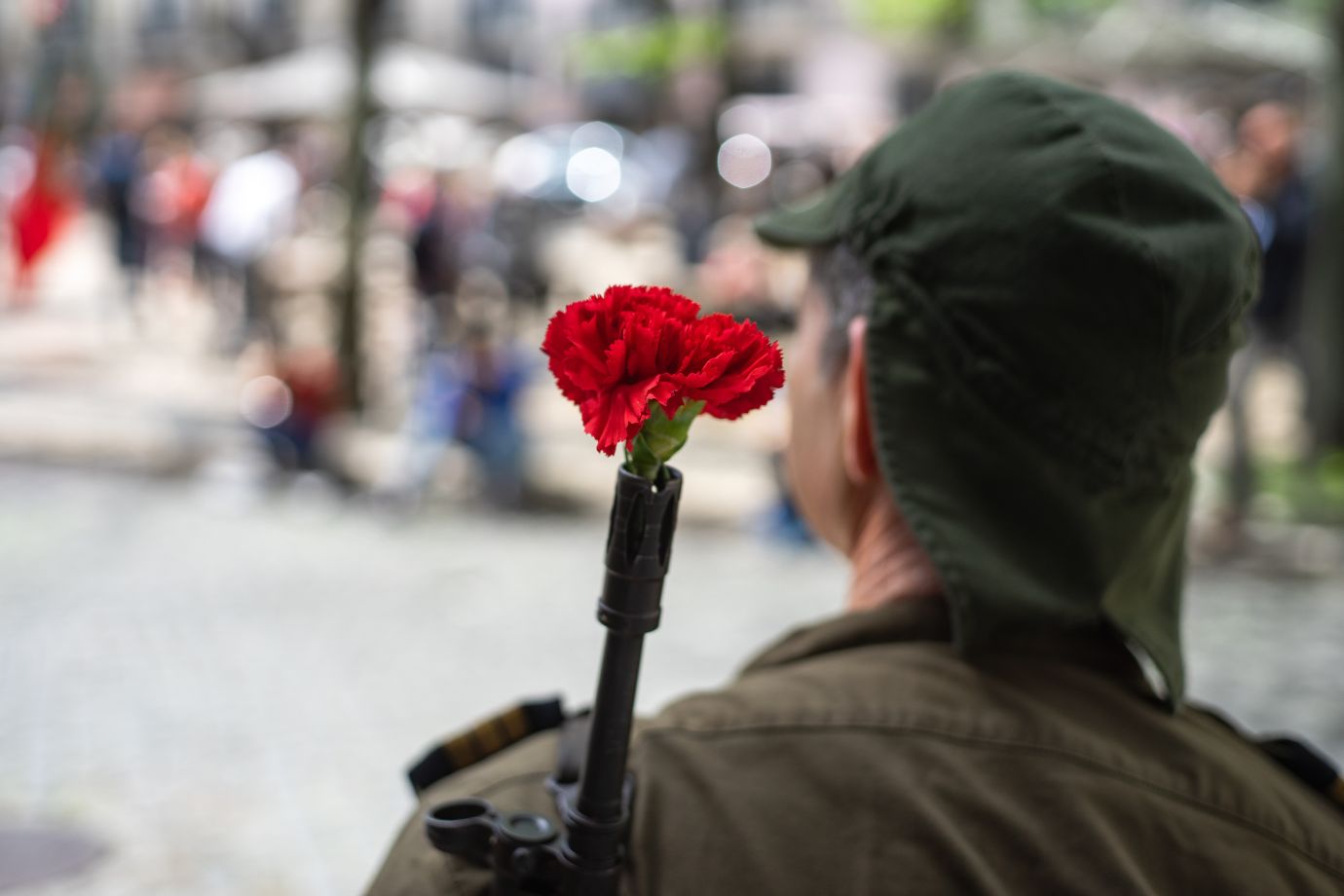
The red carnation became the enduring symbol of Portugal’s April 25, 1974 revolution.
Why Is It Called the Carnation Revolution?
The carnations were not part of the MFA’s military plan. They emerged spontaneously during the day.
Celeste Caeiro, a restaurant worker in Lisbon, had reported for work on the morning of April 25. The restaurant where she worked was supposed to celebrate its anniversary, and carnations had been purchased for customers. Because the restaurant did not open amid the military activity, the flowers were distributed to employees.
Caeiro walked toward the center of Lisbon carrying carnations. When a soldier asked her for a cigarette and she had none, she offered him a flower instead. He placed it in the barrel of his rifle. She continued giving carnations to other soldiers, and the image spread through the streets.
Other people also distributed flowers, and by the end of the day carnations had become inseparable from photographs of the uprising. The symbolism was powerful: soldiers carrying weapons whose barrels held flowers instead of firing at the population.
That symbolism should not obscure the fact that the day was not completely bloodless.
Was the Carnation Revolution Bloodless?
The coup itself was remarkably peaceful considering the scale of the military operation, and most government forces did not engage in sustained fighting. However, describing April 25 as entirely bloodless is inaccurate.
Late in the day, crowds gathered outside the headquarters of the political police — the DGS, formerly the PIDE — on Rua António Maria Cardoso in Lisbon. Agents inside the building opened fire on the crowd.
Four civilians were killed and dozens were wounded. These shootings were the principal fatal violence associated with the day and are an important reminder that the political police did not simply disappear without resistance.
Why this matters: The phrase “peaceful revolution” is reasonable when describing the overall military overthrow, but “bloodless revolution” can erase the four civilians killed by DGS gunfire. A complete history should acknowledge both the extraordinary restraint shown during most of the coup and the lives lost outside the political police headquarters.
What Happened Immediately After the Revolution?
The fall of the Estado Novo was only the beginning of Portugal’s transition. The following days and months transformed the country’s institutions at remarkable speed.
The new authorities removed President Américo Tomás and Marcello Caetano from office, dissolved the old National Assembly and Council of State, began releasing political prisoners and granted amnesty for political offenses. May 1 was established as a national holiday, and the first May Day celebration after the revolution drew enormous crowds into Portuguese streets.
Political parties that had been illegal or restricted could operate openly. Newspapers and broadcasters emerged from censorship. Exiles returned. Trade unions and political organizations expanded rapidly.
At the same time, the future political direction of the country remained unsettled. The military itself contained different ideological tendencies, while new and revived political parties competed to shape the post-dictatorship order.
The PREC: Revolution After the Revolution
The period between April 1974 and late 1975 became known as the Processo Revolucionário em Curso (PREC) — the Ongoing Revolutionary Process.
Portugal experienced political demonstrations, labor mobilization, land occupations, nationalizations and intense conflict over how far the revolution should go. Governments changed rapidly, military factions competed for influence and political parties argued over whether Portugal’s future should be liberal democratic, socialist, revolutionary or some combination of these.
Major confrontations included the political crisis of September 1974, an unsuccessful right-wing military move on March 11, 1975, and the military confrontation of November 25, 1975. The events of November strengthened moderate military forces and helped return political parties and parliamentary institutions to the center of the transition.
Free Elections and the Constitution of 1976
One of the MFA’s most important commitments was to hold elections for a constituent assembly within a year.
On April 25, 1975, exactly one year after the revolution, Portuguese voters participated in elections for the Constituent Assembly. Nearly six million people voted in the first national election of the new democratic era.
The elected assembly drafted a new constitution. The Constitution of the Portuguese Republic was approved in 1976 and established fundamental democratic rights, political pluralism, freedom of expression, freedom of religion and representative institutions.
Legislative and presidential elections followed in 1976. Portugal’s political system continued to evolve through later constitutional revisions, but the essential transition from dictatorship to constitutional democracy had been achieved.
How the Revolution Ended Portugal’s Colonial Wars
The colonial wars were one of the central reasons the MFA existed, so decolonization moved rapidly after April 25.
Portugal recognized the independence of Guinea-Bissau in 1974. During 1975, Mozambique, Cape Verde, São Tomé and Príncipe and Angola became independent.
Decolonization was politically and socially difficult. In Angola in particular, independence took place amid civil war. Hundreds of thousands of people — commonly known in Portugal as retornados, although their individual backgrounds were diverse — moved from former African colonies to Portugal during this period.
The end of empire fundamentally changed Portugal’s relationship with Africa and reshaped Portuguese society at home. For the longer background, see our history of the Portuguese Empire.
What Did April 25 Change in Everyday Life?
The Carnation Revolution is remembered not only because a government fell, but because freedoms that had been restricted for decades became part of everyday public life.
Political parties could organize openly. Citizens could criticize the government without the same system of political censorship and policing. Books, newspapers, films, music and public debate were no longer subject to the Estado Novo’s censorship apparatus.
The democratic transition also brought major changes in labor relations, social policy, education and the political participation of women. These changes unfolded over time and were often contested, but April 25 created the political space in which they could occur.
Where to Explore Carnation Revolution History in Lisbon
Much of the decisive action took place within central Lisbon, and several locations still allow visitors to connect today’s city with the events of 1974.
Largo do Carmo
The square where Marcello Caetano took refuge in the Carmo barracks and where Salgueiro Maia’s forces surrounded the government leader before his surrender.
Terreiro do Paço
Salgueiro Maia’s column occupied the government district here during the morning of April 25. The confrontation with loyalist forces became one of the crucial moments when large-scale bloodshed was avoided.
Rua António Maria Cardoso
The former PIDE/DGS headquarters stood here. A memorial plaque recalls the civilians killed by gunfire from the building on April 25.
Museu do Aljube — Resistência e Liberdade
The former prison near Lisbon Cathedral is now a museum devoted to dictatorship, political imprisonment, resistance and the struggle for freedom.
These sites can be incorporated into a broader visit using our Lisbon travel guide.
Why April 25 Still Matters in Portugal
April 25 is celebrated every year as Freedom Day, a national holiday. Red carnations remain the most visible symbol, appearing at ceremonies, demonstrations, schools, public buildings and commemorative events.
The meaning of the revolution is still debated — as major historical events always are — particularly around decolonization, the PREC and the political struggles of 1974–1975. But there is broad historical significance in the basic transformation that began that day: the authoritarian Estado Novo ended, political freedoms returned, colonial wars moved toward resolution and Portugal entered a transition that produced the democratic constitutional system of today.
In 2024 Portugal marked the 50th anniversary of the Carnation Revolution. For generations born long after 1974, the anniversary reinforced something easy to forget: many rights now taken for granted in Portugal — free elections, uncensored political debate and open political organization — were absent within living memory.
Frequently Asked Questions About the Carnation Revolution
What was the Carnation Revolution?
It was the military-led overthrow of Portugal’s authoritarian Estado Novo government on April 25, 1974. The coup was organized by the Movimento das Forças Armadas and quickly gained broad civilian support.
Why is it called the Carnation Revolution?
Red carnations were given to soldiers in Lisbon and placed in rifle barrels and uniforms. Celeste Caeiro became particularly associated with the origin of this spontaneous symbol.
Who led the Carnation Revolution?
The revolution was organized collectively by the MFA rather than by one single leader. Major figures included Otelo Saraiva de Carvalho, who helped coordinate military operations, and Captain Salgueiro Maia, whose forces played a decisive role in Lisbon.
Who was Portugal’s prime minister on April 25, 1974?
Marcello Caetano had led the government since 1968. He took refuge at the Carmo barracks during the uprising and surrendered later that day.
Was the Carnation Revolution peaceful?
It was largely peaceful for a military overthrow of a dictatorship, and widespread armed conflict was avoided. However, four civilians were killed when DGS political police agents fired on a crowd outside their Lisbon headquarters.
What song started the Carnation Revolution?
Two songs served as coded radio signals. “E Depois do Adeus” was the first signal, followed after midnight by José Afonso’s “Grândola, Vila Morena,” which confirmed that military operations should begin.
What happened to Portugal’s colonies after the revolution?
Decolonization accelerated immediately. Portugal recognized or transferred independence to its major African territories during 1974 and 1975, bringing the colonial wars to an end.
When did Portugal become a democracy?
April 25, 1974 began the democratic transition. Free Constituent Assembly elections were held in 1975, a democratic constitution was adopted in 1976, and legislative and presidential elections followed that year.
Continue Exploring Portuguese History
Sources and Further Reading
- Assembleia da República — The Democratic State and April 25, 1974
- RTP Ensina — April 25, 1974 and the Revolutionary Process
- RTP Ensina — “Grândola, Vila Morena” and the Radio Signals
- Museu do Aljube — Victims of the DGS Shootings on April 25
- Assembleia da República — Elections, Constitution and Democratic Institutions
Last reviewed September 2026.